What actually happens during a doctor home visit?
If you have never arranged one, a house call can feel like an unknown quantity. In practice it follows the same clinical shape as a clinic consultation — with more time, and none of the travel.
Key takeaways
- The visit follows the same structure as a clinic consultation: history, examination, diagnosis, treatment plan.
- The doctor arrives with a bag of common medications, diagnostic equipment and consumables — much of what a clinic keeps on site.
- You receive the same paperwork as a clinic: MC, prescription, referral letter and a visit summary where relevant.
- Expect a visit to take longer than a clinic appointment. That extra time is the point of it.
Before the doctor arrives
Booking is a short conversation rather than a form. You describe what is happening, who the patient is, and where you are; the team asks enough to judge urgency and confirms the fee for that time window. If anything in the description suggests an emergency, you will be told to call 995 instead — a good provider will turn away work that belongs in an ambulance.
It helps to have ready: the patient's NRIC or passport, a list of their current medications, and any recent discharge summary or specialist letter.
The assessment
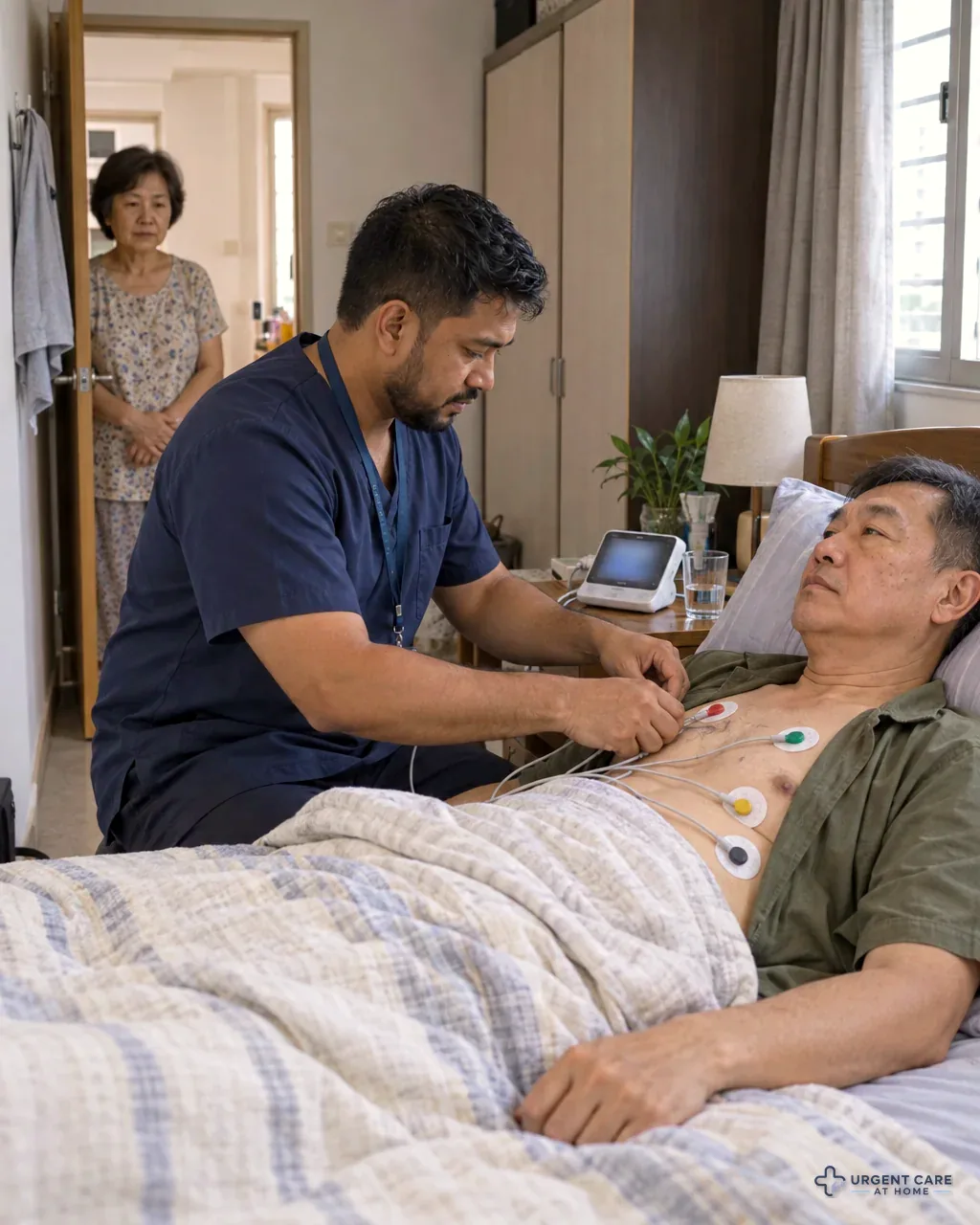
The doctor takes a history, then examines the patient — vital signs, and whatever the presentation calls for: chest, abdomen, ears and throat, the wound, the affected limb. Home visits usually allow a fuller conversation than a clinic slot does, and being in the patient's own environment often surfaces things a clinic never sees: the medication box with three duplicated drugs, the loose rug by the bed, how far it actually is to the bathroom.
What the doctor brings
- Diagnostics — stethoscope, blood pressure cuff, thermometer, pulse oximeter, otoscope, and glucometer.
- Medication — common oral medications plus injectables for nausea, vomiting and pain.
- Consumables — dressings, sutures, cannulas and IV fluids for rehydration.
What a house call cannot bring is a laboratory or an X-ray. If imaging or urgent bloods are needed to make the diagnosis safely, the doctor will say so and arrange the next step rather than guess.
Treatment and the plan
Most visits end with treatment given on the spot and a clear plan: what this is, what to expect over the next 24 to 48 hours, what would mean things are getting worse, and who to call if they do. That last part matters more at home than in a clinic, because there is no receptionist to catch a deterioration.
Afterwards
You receive the paperwork the situation calls for — a medical certificate, a prescription for anything not dispensed on the spot, a referral letter if a specialist is needed, and an itemised receipt. A visit summary can be forwarded to your regular GP or a treating specialist on request, which is worth doing for anything ongoing.
Common questions
How long does a doctor home visit take?
Longer than a clinic appointment — commonly 30 to 45 minutes depending on the complexity. The additional time for history and examination is one of the main reasons families choose a home visit.
What equipment does a house call doctor bring?
Standard diagnostic equipment including a stethoscope, blood pressure cuff, thermometer, pulse oximeter, otoscope and glucometer, plus common medications, injectables, dressings and IV fluids.
Can the doctor do blood tests or X-rays at home?
Imaging is not possible at home, and laboratory testing is limited. If a diagnosis needs bloods or an X-ray to be made safely, the doctor will arrange that rather than guess.
Do I get an MC from a home visit?
Our doctors are registered with the Singapore Medical Council and can issue medical certificates, prescriptions and referral letters. An MC certifies that you are unfit for work, so it is issued where the examination supports it rather than automatically.
What should I prepare before the doctor arrives?
The patient's NRIC or passport, a list of current medications, and any recent discharge summary or specialist letter. Clear access to the patient and a well-lit space to examine them also helps.
